Thanks to Yahsin Huang and Anton Cheng for review and feedback.
After reading various books in humanities and social sciences, I’ve discovered some tendencies. It seems many topics ultimately converge on economic growth.
- Four Hundred Years of Taiwan’s Economy discusses Taiwan’s economic growth history
- Poor Economics examines why extremely poor people cannot escape poverty through accumulating capital on their own. The underlying theory is basically an economic growth model, exploring what “traps” appear on the growth path that keep poor people in poverty traps.
- Power and Progress also has an economic growth model at its core, but emphasizes the parts where people can direct technological development. The authors lean left economically.
- I’ve watched many interviews and read blogs by John Cochrane, mainly to learn his monetary theory. He’s an ultra-right economist. He believes economic growth is the holy grail of economics, and he can only contribute some trivial monetary theory.
- Working to Live. The author, more of an anthropologist, advocates for a degrowth direction.
- I haven’t read Capital in the Anthropocene, but it seems to have high discussion levels in Taiwan. The author also advocates degrowth.
The general impression is that economists mostly support economic growth. Often economic growth is treated as the solution to all problems. Sociologists, anthropologists, and environmentalists tend toward degrowth.
Economic Growth: History and Review
Recently I saw the book Growth: A Reckoning in a bookstore. The author is Daniel Susskind; Taiwan has published his previous book “A World Without Work.” I was initially hesitant about whether to really spend time on the topic of economic growth, but bought Growth when I saw it in a second bookstore. I find this book quite efficient—it answered many questions I was curious about, exceeding expectations.
Although the book’s title is economic growth, that’s more an economist’s term. For readers concerned about technology and the future, I think it’s an excellent read. Economic growth tells you the priorities among technology, ideas, capital, machinery, labor, education, and so on. The book’s writing style breaks out of the circle, assuming readers have little economics knowledge and explaining core concepts with very fluid prose. It also critiques degrowth supporters on the left and full free market/free trade supporters on the right. Finally, it criticizes the longtermism popular in Silicon Valley circles.
As Nobel Prize winner Robert Lucas (who died last year) said: “Once one starts to think about economic growth, it is hard to think about anything else.”
The author believes pursuing economic growth is a very new, mysterious, and dangerous human activity. New because sustained stable economic growth only began in the second half of the 20th century. Mysterious because we don’t know why past growth succeeded. Dangerous because economic growth has great potential but also great costs.
For economists, in all of human history, only three things matter. The first 300,000 years were a great stagnation without growth. Then modern economic growth began 200 years ago, though unstable. Only about 100 years ago did we have sustained stable growth.
Under Great Wars, Economic Growth Becomes Popular
Classical economists had no concept of economic growth. The pursuit of economic growth was somewhat accidental. In 1940, to fight World War II, Keynes had to design a system to measure national output to know how many war resources he could raise for Britain, thus creating GDP’s predecessor. In 1933 America experienced the Great Depression, and Kuznets also designed a system to measure national output to understand how bad the Depression really was.
Why did no one think to do something similar before 1930? Because designing national wealth indicators was dangerous. Those who told the truth got their heads chopped off.
The main difference between their two designs was that Keynes, raising money for war, included military spending. But Kuznets considered military spending evil and shouldn’t be included in the indicator. America chose Keynes’s design in 1940—after all, during wartime, defense is very important.
During the Cold War, the US and USSR had to compete on resource output, comparing GDP daily. Another factor pushing GDP internationally was the Marshall Plan: countries receiving aid had to establish statistical indicators to measure aid effectiveness.
Thus under hot and cold wars, suddenly all countries worldwide had GDP indicators.
Economic growth indeed brings many benefits. Economic benefits include reducing poverty. Non-economic benefits include healthier lives, more education, and greater happiness.
For national leaders, focusing on GDP growth has many conveniences. Under economic growth, the unemployed find work, and economic benefits from growth can pay for other social issues. Another benefit is that focusing on growth can delay discussion of all social problems and avoid social conflict.
But economic growth also has many costs, including climate impact, increased inequality, and threatened jobs.
Balancing Economic Growth and Its Costs
So what does the author think should be done to solve or balance the benefits and costs of economic growth?
Before that, let’s see what approaches the author disagrees with:
Some think since GDP overly focuses on material production without considering climate impacts and inequality, why not design a better indicator and everyone pursue that new indicator? The problem is that indicator design buries moral questions in technical details. For example: How much should we value climate impact? This is a moral question, but in indicator design, it might just become a parameter weight.
Therefore the author believes that while GDP’s technical problems need time and effort to solve, we shouldn’t expect to design a perfect new indicator and just focus on maximizing that number. The author thinks a dashboard approach, listing various issue indicators for people to discuss, is better.
The second approach is degrowth. The author spends effort laying out the historical context of degrowth thinking. But the most popular myth is “Earth’s resources are limited, how can they support infinite economic growth?” The problem with this myth is viewing economic activity with outdated perspectives, only seeing the material part.
Economic growth isn’t driven by using more limited resources, but by discovering more ways to better use limited resources. Paul Romer has a vivid description: ingredients in a kitchen are limited, but recipes these ingredients can form are nearly infinite. 300 ingredients can combine into more recipes than atoms in the universe, even without considering different proportions. People might say most recipes would be useless, but the explorable space remains huge. The curse of dimensionality is a blessing here.
Abandoning the full pursuit of growth has many levels—you could choose to slow growth, but degrowthers often choose the most extreme negative growth route.
Therefore, the author’s biggest criticism of degrowthers is lack of imagination, choosing the most extreme solutions and utopian project routes. But the author still thinks degrowthers’ arguments deserve engagement, partly because their arguments are popular. Also, the current situation somewhat pursues economic growth at any cost, while degrowthers abandon growth at any cost. We can choose a middle path between these.
Liberating the Production of Knowledge and Ideas
Having discussed new indicators and degrowth, we can discuss what the author considers the right path for growth.
But first we need some background on what efforts humanity has made and what mistakes we’ve committed in understanding economic growth. The author summarizes four basic approaches:
The first is writing ten-thousand-word essays trying to organize a narrative like social theory—this approach is a major failure, with no successful predictions.
The second and most successful is concise mathematical models. Harrod and Domar discussed combinations of labor and capital, physical capital investment and economic growth. Solow and Swan improved the former model, adding technological factors. This is important—humans initially trapped in great stagnation because labor productivity has diminishing marginal returns. One more person means two more hands to work, but also one more mouth to feed. The extra hands produce diminishingly, unable to feed the extra mouth, trapped in the Malthusian trap. Therefore more people doesn’t help—the game of economic growth requires increasing the average economic fruits per person to count as growth.
Technology’s power is that it changes production methods, offsetting diminishing marginal productivity of labor and capital.
Robert Lucas and Paul Romer further discovered the importance of human capital and skills. Investing in education also improves production efficiency.
The third is data analysis, but the author says every data analysis result has multiple interpretations. This approach doesn’t contribute much.
The fourth pursues fundamental approaches. Are there fundamental reasons causing economic growth? Jared Diamond’s geography, Max Weber’s work ethic, Douglass North’s institutions, Daron Acemoglu and James Robinson’s extractive and inclusive institutions belong to this category. The author most likes the combination of Joel Mokyr’s “A Culture of Growth” and Paul Romer’s intangible knowledge model. Though the author notes Mokyr and Romer don’t acknowledge each other, never citing each other’s research.
With this background, the author believes pursuing economic growth means asking how to pursue technological development and increase production of knowledge and ideas. The author thinks four things need addressing:
First is asking who owns and controls knowledge and ideas: intellectual property rights. IP protection provides inventors incentives to invent. Too short protection and no one wants to invent; too long and knowledge can’t circulate to have impact. The author notes current IP systems have problems of being outdated (protection too long), excessive (protection overly granted), and weaponized (used for anti-competitive purposes).
Second is increasing R&D investment. Currently worldwide average R&D investment is 1-4% of GDP, with the top three: Israel about 6%, Korea 5%, Taiwan 4%. Countries and large companies are somewhat unfair, but big tech companies’ R&D as percentage of profit: Alphabet 15%, MSFT 13%, FB 21%. The author thinks countries should raise R&D percentages even higher.
Third is getting more people involved in R&D. Research shows low-income people are less likely to become inventors when they grow up. If this problem can be alleviated, it can both solve opportunity inequality caused by income and promote growth through more people participating in R&D.
Fourth is increasing researcher efficiency. Our research efficiency has decreased, the lowest-hanging fruit seems picked:
- Moore’s Law has indeed held steady from 1970 to today, but achieving the same effect today requires 18 times more human effort than 1970.
- Discovering the God particle used 5,000 researchers, with a 33-page paper having only nine pages of actual content, the remaining pages listing author names.
- University administrative bloat: Harvard has 7,000 undergraduates but 7,000 administrators.
- Researchers spend 40% of their time applying for funding.
- Recent surveys show 80% of researchers, constrained by funding conditions, research topics they don’t like.
The author mentions that improving research efficiency might not be possible through humans alone. For protein folding, previously researching one protein’s 3D shape used up almost an entire PhD career, and today only 17% of known proteins’ 3D shapes are known. But in 2022 DeepMind’s AI discovered 100 million protein 3D shapes in one go.
But the most interesting part of the book is what the author thinks cannot boost economic growth much:
- Building bridges and roads, more infrastructure: Large projects waste lots of money. And this thinking falls into capital-oriented thinking. In growth models, marginal utility of capital increases diminishes. So theoretically unfeasible.
- Better land use and urban planning: Paul Romer likes cities because he thinks they let many people meet in the same place, promoting knowledge exchange, and knowledge is the nutrient for economic growth. But the author thinks there’s no empirical data support—with remote work technology prevalent today, is physical meeting really that important?
- Increasing education: Few countries can get 90% of people through middle school, 50% through college. The author thinks the past “century of human capital” can’t happen again. I think this is the author’s most interesting view. I also thought educational improvement should have lots of potential. But even if we could double people’s abilities? Or even ten times? Can it compare to AI productivity improvements like protein 3D structures?
The Direction of Growth
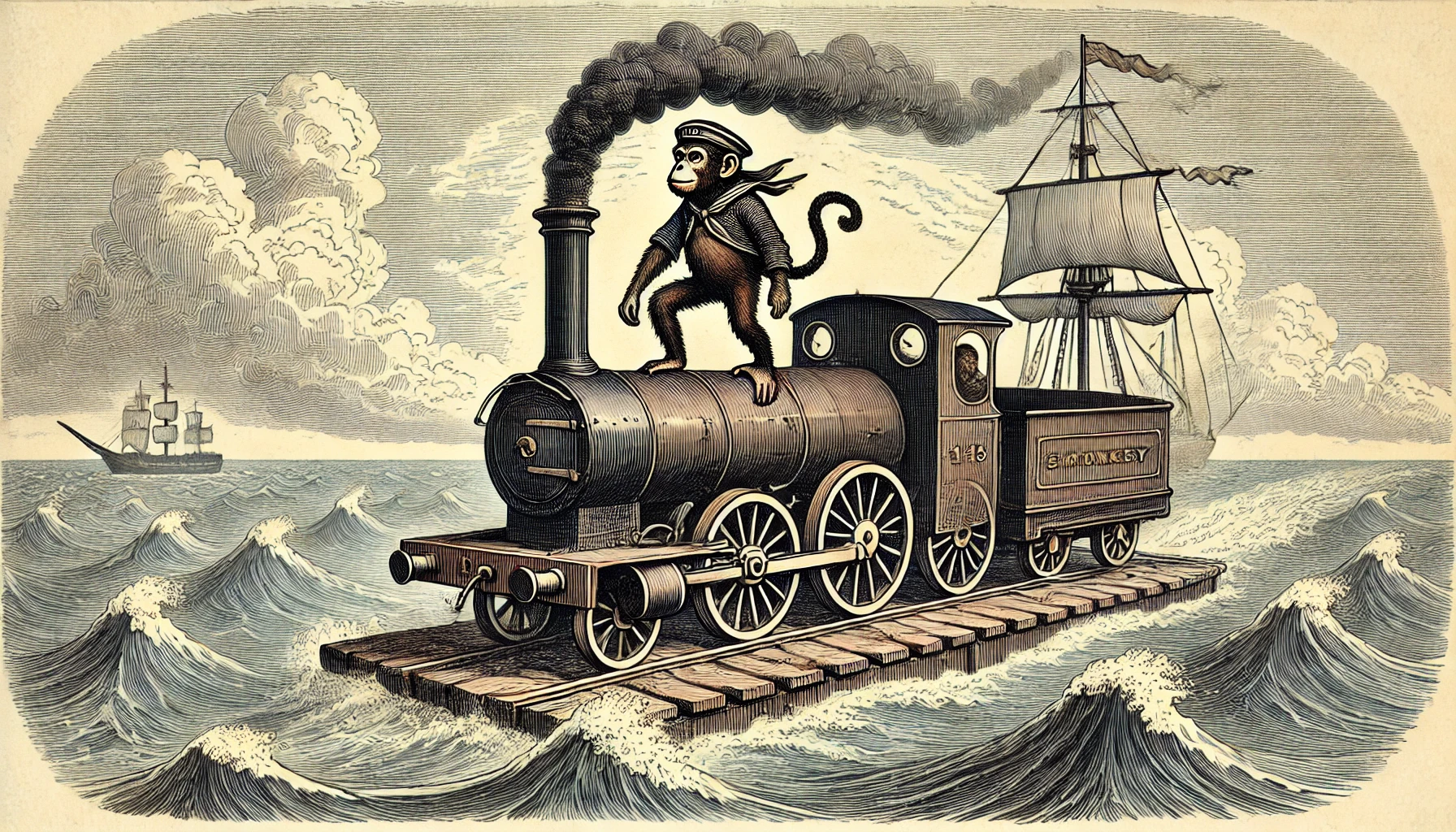
The author notes people easily think of economic growth like a locomotive. Growth supporters think we should accelerate, degrowthers think we should slow down or reverse. But this metaphor’s problem is viewing growth like railroad tracks with only one direction, only forward or backward.
A better metaphor is a ship in the ocean—the ship can advance in different directions, and when looking at growth we also need to choose which direction to advance.
An important observation: the same 5% growth in Britain—today’s 5% produces very different things than 5% a hundred years ago.
The difference of course is we now have completely different technology. But is technological development something we can control?
The author distinguishes two concepts: induced technological development and directed technological development.
An example of induced technological development is Britain’s Industrial Revolution. Why didn’t people in nearby Germany, France, and Belgium develop the Industrial Revolution at the same time? Because Britain at that time had both high wages and low fuel costs, making it profitable to invest in improving steam engines to replace workers. Similar examples include: Japan’s advanced care robots because of large elderly populations and low immigration. And China’s industrial robots, because the low-wage environment manufacturing previously relied on no longer exists.
People’s understanding of directed technological development has greatly increased recently, mainly through [[Daron Acemoglu]]’s research. The main arguments are roughly the content of the Power and Progress book. Generally, those factors or incentives inducing technological development aren’t completely beyond our control. Through taxes and subsidies, regulations, and changing social norms, we can direct technological development’s direction.
- Pandemic isolation policies can be viewed as making the wage cost of hiring people into offices infinitely high, thus inducing technologies and cultures like Zoom and Skype for remote work. These policies catalyzed these technologies’ progress.
- Early in the pandemic, vaccines were expected to take ten years to develop. But we had AZ and BNT after eight months. Moderna and J&J came months later. This was also infinite wage costs creating strong incentives for vaccine development.
- On the negative side, many companies automated jobs requiring face-to-face contact prone to infection in response to the pandemic. This created difficulties for many workers.
The theory of directed technological development faces challenges from both left and right.
The right, like market fundamentalists at the Hoover Institution, say directed technological development is policy intervention disrupting normal market price mechanisms. The author’s rebuttal is that when we act as “consumers,” market mechanisms reflect what we care about. But when we act as “citizens,” market mechanisms struggle to reflect our concerns. The author also responds that directed technological development isn’t central planning.
The left criticizes directed technological development as still using property rights, incentives, and market mechanisms to consolidate economic growth and capitalism, like asking ghosts for prescriptions. The author reminds them they forget leftist literature’s roots: economic growth isn’t unique to capitalism. In former socialist societies, they valued growth even more than capitalist societies and took pride in material output quantities.
The author quotes Derek Parfit: We are at a turning point in history. Technology has changed rapidly over the past 200 years. We will have greater ability to change the environment, even ourselves or our descendants. If we take wise actions in the coming centuries, humanity can survive this most dangerous and critical period.
The author says if we have more ability to change the future, that means the past can give us less experience. For example: people previously criticized “Green Growth” as impossible, but with current information, this is extremely likely in the future.
If technological development really can be directed, this also means we have moral responsibility for our chosen directions.
Growth’s Trade-offs and Moral Responsibility
As mentioned, economic growth has costs like climate impact, increased inequality, and threatened jobs. How do we make trade-offs among many valued priorities?
First the author discusses: are trade-offs necessary? Maybe we can first think if there are ways to avoid trade-offs (Pareto improvements)? If complete avoidance is impossible, are there ways to weaken trade-offs? After exhausting these options, we can discuss trade-offs.
- Avoiding trade-offs
- As mentioned, giving low-income people more opportunities can simultaneously improve inequality and promote growth.
- Weakening trade-offs
- The author spends much effort discussing green growth: increasing economic growth without increasing environmental burden.
- 2007 Stern Review: Reducing CO2 to below 80% of current levels would cost 1% GDP annually.
- But by 2020 Climate Change Committee: Complete elimination of carbon emissions only needs 0.5% GDP cost.
- 1976 solar price was $100 per watt. By 2019 it became $0.5 per watt.
- IEA: Predictions for 2030 global solar use. 2021 predictions are 30 times higher than 2006 predictions. Solar expected to surpass coal and natural gas by 2027.
- Green decoupling: Many countries experiencing GDP growth while simultaneously reducing carbon emissions.
- Green decoupling results from collective efforts of inventors, entrepreneurs, etc. Shaped together through culture, institutions, taxes and subsidies, regulations, and social narratives and norms.
- Russia-Ukraine war indirectly caused Europe’s green transition after Russia cut natural gas.
- Automation
- Bill Gates observed: Why do workers pay taxes, but when factories replace workers with robots, robots don’t pay taxes? This reflects that while labor and capital are both production factors, labor is too easily taxed.
- Readers might want to tax capital to reduce growth’s trade-off with inequality. But taxing capital requires care—carelessly done easily produces opposite effects.
- The author spends much effort discussing green growth: increasing economic growth without increasing environmental burden.
After discussing avoiding and weakening trade-offs, we can discuss accepting trade-offs.
Discussing trade-offs between growth and environment, inequality, etc., is really discussing balancing present and future people’s interests. Insufficient growth now leaves the future fewer means to solve problems, but we also can’t leave future people messes of inequality and pollution.
Economics has a topic of “intergenerational equity.” Usually using a parameter like discount rate to express how we balance present and future people’s interests.
The author believes current people and culture are indeed short-sighted. Companies maximize short-term returns to please investors, governments pursue short-term achievements to please voters, and citizens are troubled by daily worries. This is an extreme emphasis on the short term.
As a comparison at the other extreme, the author mentions Silicon Valley’s popular longtermism (he calls it an “extremely helpful mistake”).
Longtermism focuses on millions, tens of millions, or billions of years later. Humanity has broken through 80 trillion population, at that furthest number, Earth has been swallowed by the burning sun, people are floating in outer space.
Longtermists believe we should work for the welfare of those far-future people, because they vastly outnumber us.
But the author says the future longtermists want to protect is too distant and beyond our imagination. We might soon succeed in longevity movements, breaking through longevity escape velocity, or upload our minds for digital immortality. But these things already exceed our imagination, let alone things thousands or billions of years away.
The author quotes Regina Rini: “Our attempts to predict the needs of interstellar travelers millions of years hence are as impractical as a Paleolithic chieftain preparing sharp flints for 21st-century spearheads.”
The author also takes a jab at important longtermist supporter SBF: “Turns out humanity’s deadliest threat isn’t future nuclear war or superintelligent AI, but a thirty-year-old curly-haired billionaire in our time.” His FTX exchange’s terrible internal controls caused disaster.
Because future technological development is unimaginable, the author believes we should embrace “imaginative humility” and “practical humility” in viewing the future’s demands on the present.
So what do we owe future people? The author believes we should care more about the future than modern people do, but focus on nearer things than longtermists. We can’t argue about decimal points in discount rates like economists, but must argue about trade-off directions for various issues.
For moral questions, the author ultimately throws out the answer “let citizens decide.” The author mentions mechanisms like Mini-publics similar to citizen judges, sampling citizens nationally to find answers for specific issues.
Conclusion
The author basically discusses economic growth’s origins, what research people have done, and discusses growth’s benefits and costs. In balancing benefits and costs, it’s not as extreme as blindly pursuing growth or completely abandoning growth, but there are many directions and middle grounds for trade-offs.
I think this book is the confluence of several things I’ve recently read:
- I can understand why Glen Weyl emphasizes research on increasing returns so much (too many Nobel Prizes now go to research on decreasing returns).
- The economic importance of knowledge and ideas.
- Why directed technological development discussed in Power and Progress is important.
- How to understand various new technologies from an economic growth perspective.
I also saw many previously unnoticed important things. For example, green energy development, protein folding.